Fondly referred to as “Germany’s secret capital,” Munich is near the Alps and well-placed for cooling off in lakes on summer days, while browsing traditional Christmas markets proves fun in winter. The home of the original Oktoberfest is a year-round destination with beer gardens and a vast English Garden that is popular on sunny days. Options for art aficionados include the museums in the art district and performances by the state opera and orchestra.
Here are the best neighborhoods to visit in Munich. As always, check for travel guidelines and closures before planning your trip.

Altstadt (Old Town)
Marienplatz, the public square in front of the neo-Gothic New Town Hall, is considered the heart of Munich. Join crowds below the ornate clock tower at 11 a.m. and noon, plus 5 p.m. from March until October, to see mechanical figures recreate key scenes from the city’s history as bells chime.
In the winter, browse handcrafted seasonal decorations and sip aromatic mulled wine on Marienplatz while visiting wood huts at Munich’s oldest Christmas market. Several other Christmas markets are held across Bavaria’s capital, including a medieval-style market at nearby Wittelsbacherplatz. Spiced nuts count among seasonal delicacies sold from stalls at Sendlinger Tor, one of the historic city gates.
Whatever the time of year, pause at the Viktualienmarkt to find the likes of Bavarian cooked meats, freshly baked bread, and pressed fruit juice for a lunch on the go. Choose from seasonal dishes accompanied by regional wine at the Pfaelzer Residenz Weinstube.
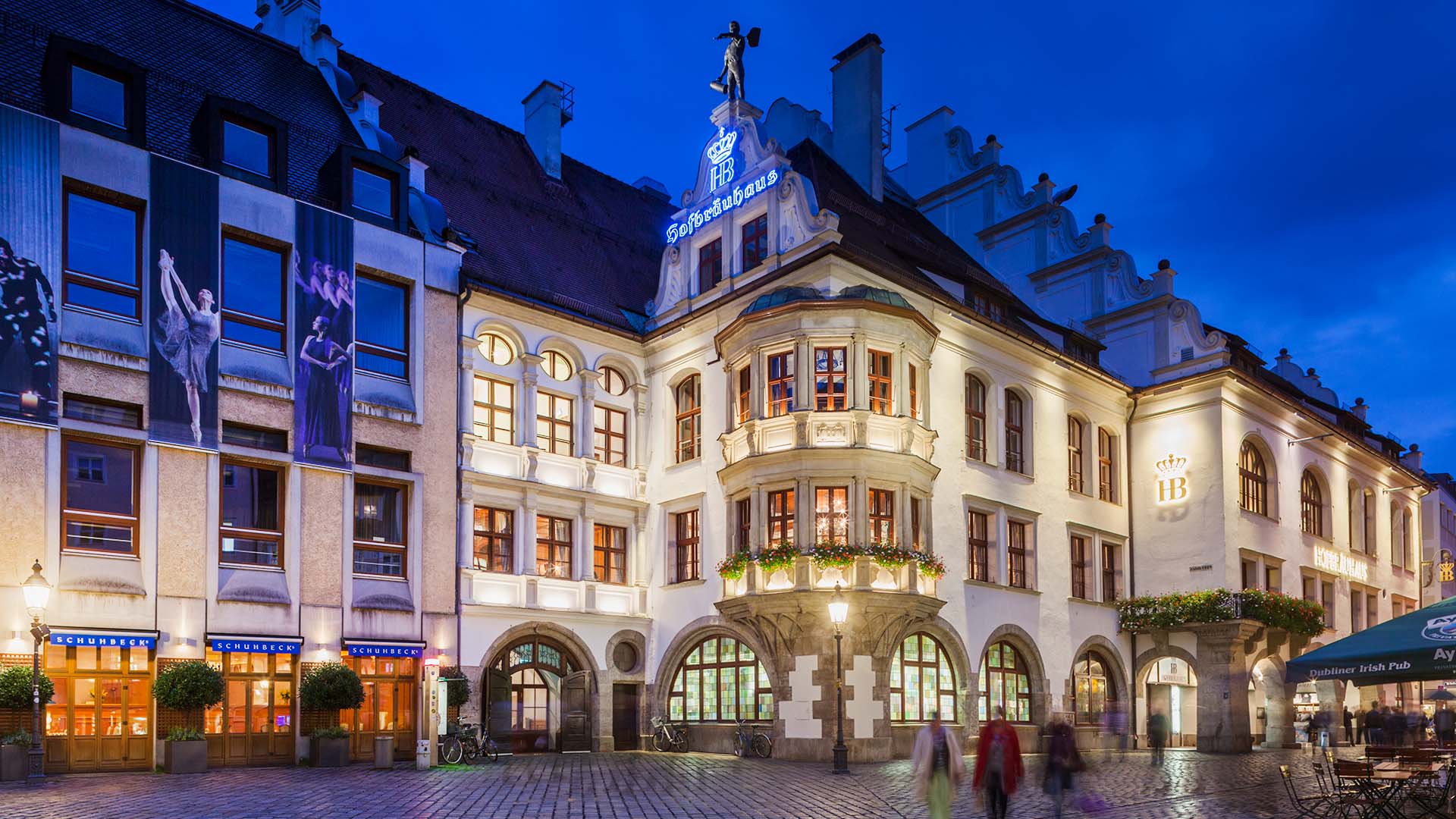
The Munich Residence, the urban palace from which Bavaria was formerly ruled, counts among historic places to visit in the Altstadt. So too does the Hofbrauhaus, Munich’s best-known beer hall. It doesn’t have to be Oktoberfest for you to sip beer and sway to a brass band’s jaunty tunes.
Climbing the 306 steps in the tower of St. Peter’s Church is one of the best things to do to orient yourself in Munich. Predating the city’s iconic twin-domed cathedral (the Frauenkirche), “Old Peter” is the city’s oldest church. Its observation platform gives you panoramic views of the urban skyline and even the Alps in optimal weather.
After sightseeing, you can relax with a cocktail in the stylish Oléo Pazzo Bar inside the nearby Courtyard by Marriott Munich City Center. Oléo Pazzo Restaurant is a welcoming place to sit, unwind, and nibble Mediterranean cuisine. Alternatively, return to Aloft Munich, close to the central railway station, to sample nightlife at w xyz Bar, whose signature cocktails include expertly mixed piña coladas.


Enjoy tranquil moments and stunning views at Koenigshof, a Luxury Collection Hotel, Munich. (Photos: Marriott International)
For a luxury escape, stay at Koenigshof, a Luxury Collection Hotel, Munich, with rooms designed as havens of tranquility and Private SPA, where breathtaking relaxation experiences await — including unforgettable panoramic views over the rooftops of Munich.
Maxvorstadt
Immediately north of the city center, Maxvorstadt is characterized by broad streets and elegant 19th-century buildings. Pause at Alter Simpl on Turkenstrasse to sample traditional Bavarian dishes such as white sausage with pretzel or pork cutlet filled with horseradish and ham. Culturally significant in the early part of the last century, this tavern was a meeting place for artists: Framed photos of guests from that era are displayed on the walls.
Artworks by the likes of Albrecht Dürer, Vincent van Gogh, and Cy Twombly are shown in the galleries of the art district. The Alte Pinakothek, Neue Pinakothek, Pinakothek der Moderne, and Brandhorst Museum are near neighbors. Spanning centuries, their highly regarded collections warrant viewing over multiple days.
Stay nearby at Le Méridien Munich, where you’ll find a spacious lobby and courtyard seating. Book a treatment at the spa to unwind before dinner at Irmi, its Bavarian restaurant. Spätzle, a form of hand-rubbed pasta baked with cheese, is a regional specialty ideal for replenishing your energy after a busy day.
Glockenbachviertel Allianz Arena
Gaertnerplatz square is the location of the State Theatre, a building from the 1860s with programming that includes opera, ballet, and classical concerts. Characterized by independent boutiques and laid-back eating establishments, the Glockenbachviertel hugs the sweep of the river for several blocks, beginning immediately southwest of the theater.
This is where to go to find the heart of Munich’s thriving LGBTQ+ scene. The Deutsche Eiche Bathhouse, Ochsengarten bar, and Café Nil count among the long-established focal points. Pride Week, during July, sees parades and events in the Glockenbachviertel and elsewhere in the city.

Neuhausen-Nymphenburg
Located three U-Bahn (underground train) stops east of the city center, Rotkreuzplatz square is at the heart of Neuhausen and hosts a compact Christmas market. Locals rate the handmade ice creams of Sarcletti among the best in the city: Standing in line on summer weekends is worth the wait.
Stroll north along Nymphenburger Strasse to visit Nymphenburg Palace. Designed by Augustino Barelli in the 1660s, the summer residence of Bavaria’s rulers is in parkland dotted with statues, follies, and the grand Amalienburg hunting lodge, whose mirrored interiors are well worth a peek.
A canal provides a formal symmetry to the palace grounds, which adjoin the city’s gorgeous botanical garden. Following the waterway toward the Olympic Park takes you to Dantebad, a heated outdoor swimming pool, public sauna, and park. Enjoy freshly prepared, Bavarian-sourced meat and vegetable dishes in the nearby Taxisgarten beer garden.

Schwabing
Schwabing lies north of the city center and is a good location for people-watching from the streetside seating of cafés, bars, and restaurants. Reach the longstanding nightlife hub by ambling past the Siegestor triumphal arch, one of Munich’s key landmarks, and along Leopoldstrasse.
The Tante Emma bistro serves currywurst, Germany’s most popular snack. Take your pick from Schwabing’s cluster of drinking establishments. Cocktails are served into the small hours at Wallace Bar, where wood paneling and subtle lighting foster a sophisticated vibe. For an authentic Turkish kebab, visit Türkitch on Feilitzschstrasse.
Sandwiched between Schwabing and the River Isar is the English Garden. The name of the enormous urban park reflects its naturalistic, English-influenced landscaping. Mount the base of the templelike Monopteros to appreciate the cityscape. Surfing the waves of the Eisbach canal, on the park’s southern edge, is one of the unique things to do in Munich. The waterway’s name translates to “ice brook,” a reference to cool meltwater from the nearby Alps.
Staying at the nearby Munich Marriott Hotel places you in a smart property with a spa and health club. If you don’t manage to get tickets to a soccer game at the , watch it live in the hotel’s Champions Sports Bar. There’s also The Westin Grand Munich and Four Points by Sheraton Munich Arabellapark — both of which have breathtaking views across the city and are about a five-minute drive from the English Garden.
Schwanthalerhöhe (Westend)
Westend, another name for Schwanthalerhöhe, accurately indicates that the district lies west of the city center. Open ground at the Theresienwiese is the traditional home of Oktoberfest and the significantly smaller Spring Festival. Carnivals with carousels and roller coasters stand tall next to beer tents.
Tollwood Winterfestival, an alternative Christmas market with handcrafted goods and cuisines from around the world, is also held at the grounds. Throughout the year, the site worth visiting to see the bronze statue of Bavaria, designed by Ludwig Michael von Schwanthaler.
The colossal sculpture stands in front of the colonnaded Hall of Fame, a 19th-century construction celebrating high-achieving Bavarians. Beyond the neighboring Bavaria Park you’ll find the Verkehrszentrum (the Deutsches Museum’s transportation museum). Cars, trams, and buses count among artifacts on show.
For something special, The Dean Munich, Autograph Collection is notable for its upscale contemporary design, indoor infinity pool with a cinema screen, and fashionable Ibasho Restaurant, where Japanese cuisine is inspired by seasonal flavors. Alternatively, stay at Munich Marriott Hotel City West, where sophistication meets Bavarian charm with a rooftop terrace, Cloud 6, where you can enjoy enjoy seasonal pop-up events with panoramic views of Munich and the Alps.

Haidhausen
East of the River Isar, the Haidhausen district is occasionally referred to as Munich’s French Quarter because of streets named after cities in France.
Bavaria’s state parliament meets at the Maximilianeum, an imposing mid-19th-century building topped by sculpted figures. Members of the public can enter the Maximilianeum and other municipal premises during Open Door Day, usually held in May.
If you’re seeking authentic, interesting things to do, try a textile-free (nude) sauna at the riverside Müllersches Volksbad. Inspired by Roman bathhouses and incorporating Jugendstil (German art nouveau) design, the building houses Munich’s oldest indoor swimming pool.
Stroll just a couple of minutes from the baths to the Deutsches Museum, whose array of technological exhibits and live demonstrations warrants at least a half-a-day visit. It’s possible to view a V2 rocket and watch artificial lightning zapping a Faraday cage. Also check the events calendar at the Gasteig, a performing arts center with five halls, to reserve tickets for concerts, plays, and cultural events.
Get to know the city during an extended stay in one of the roomy apartments at Residence Inn by Marriott Munich City East. If you’re interested in exploring the multiuse Werksviertel district, consider Residence Inn by Marriott Munich Ostbahnhof and Moxy Munich Ostbahnhof — both ideally located for visiting the dynamic, creative area that’s daubed with colorful street art and home to several nightclubs.
Go Deeper: Some Helpful Tips for Visiting Munich
In any new city, it’s handy to know some of the most important phrases, and in Munich, you’ll likely want to know how to order a beer. Say “ein Mass, bitte” in a pub in this part of Germany and you’ll be served a liter of beer. People drinking wheat beer (Weissbier) clink together the bottoms of their glasses rather than the rims as they say “prost” (cheers).
You can use “gruess Gott” as a greeting at any time of day — a legacy of Roman Catholicism’s historic significance in Bavaria, it translates literally as “greet God.”
Munich’s well-planned public transportation system is reliable and easy to use. Download the Munich Transport Association app to plan your journeys, including out to Lake Starnberg, one of the lakes south of the city. Alternatively, cabs are plentiful.
Related Articles


